The rooms we return to in memory, the ones where something was exactly right, are rarely the perfect ones. An argument for materials that have a relationship with time, and the spaces that are only just beginning on the day they are completed.
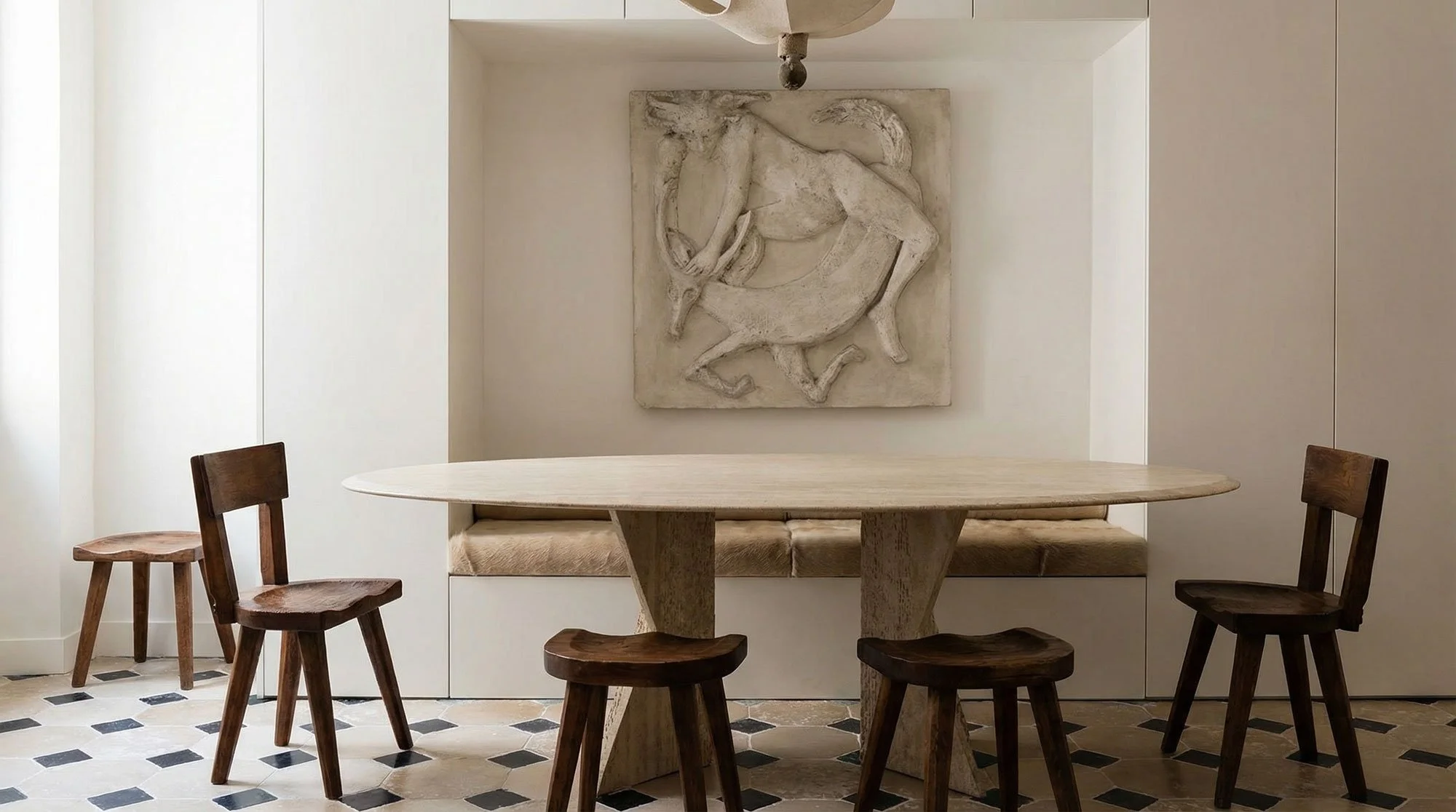
I have a particular weakness for materials that aren't entirely perfect.
Stone with unexpected veining. Timber with knots and variations in grain. Plaster that reveals the hand of the person who applied it. The kind of things that might be considered imperfections in a showroom, but to me, are precisely what make a material worth choosing.
Take travertine, for example.
I love it in its more natural state. Honed rather than highly polished, with its characteristic pores, little cavities and irregularities left visible. There's something incredibly beautiful about a material that doesn't try to disguise where it came from.
Of course, this comes with a few considerations.
Natural stone can stain. Unfilled travertine can collect dirt in its little pockets. Brass will develop a patina, timber will change colour, and that gorgeous linen sofa will eventually look as though someone has actually sat on it.
Which, hopefully, someone has.
I completely understand why this makes some people nervous. When you've invested in beautiful materials, the instinct is to keep them looking exactly as they did the day they were installed.
But I've always found that idea a little contradictory.
We fall in love with natural materials because of their character, their variation, their individuality. And then, sometimes, we expect them to behave like something manufactured.
There's a certain irony in that.
I think about this often when choosing finishes for a home. The beautiful unpredictability of limewash, the subtle movement in Venetian plaster, the irregular edges of handmade tiles. Even something as simple as an aged bronze handle, which will gradually develop its own character through years of use.
These materials aren't static. And that's part of their appeal.
There's a Japanese philosophy called wabi-sabi, which finds beauty in imperfection, impermanence and the natural passage of time. It's an idea I've always felt drawn to, particularly when it comes to interiors.
Not because I believe everything should look old or weathered. Quite the opposite. I love the contrast between something beautifully refined and something a little rough around the edges.
A perfectly detailed piece of joinery against a textured plaster wall. An elegant contemporary chair beside an antique table. A dramatic slab of marble with veining that refuses to behave itself.
It's often those contrasts that make a room interesting.
And I think the same applies to the way we live in our homes.
Some of the most memorable interiors I've encountered aren't necessarily the most immaculate. They're the ones with furniture collected over time, objects that have travelled, materials that have softened with age and little details that tell you something about the people who live there.
They have personality. A sense of ease. The feeling that life is actually happening within them.
That's not to say I don't appreciate precision. I absolutely do. I can spend an unreasonable amount of time considering the alignment of a joinery detail, the proportions of a stone edge or the exact position of a wall light.
There is a time and place for perfection.
I just don't think every surface needs to aspire to it.
And of course, there's a practical side to all of this. Natural materials aren't necessarily right for everyone. Some require more maintenance than others, and understanding how they'll perform over time is just as important as appreciating how they look.
I'd much rather someone choose a material knowing exactly what they're getting into than spend the next ten years worrying about every little mark.
A home should be lived in, after all. Not tiptoed around.
Perhaps that's what I love most about materials that age gracefully. They allow a home to evolve. The brass becomes softer, the timber develops warmth, the stone carries subtle traces of everyday life.
Not every mark will be beautiful, and not every material improves with neglect. But there's something rather lovely about accepting that a home will change as the people living in it do.
I don't want to design rooms that look their best only on the day they're photographed.
I want to design rooms that become more interesting with time.
Because a beautiful home shouldn't feel finished the moment you move in.
In many ways, that's when the best part begins.
Recent Posts


A maximalist at heart, I've always loved bold colours, beautiful objects and interiors with personality. But over time, I've come to appreciate the art of knowing when enough is enough. A reflection on restraint, the Italian concept of sprezzatura, and why the most interesting spaces aren't always the ones with the most to say.