Some places are difficult to describe. This is one of them.
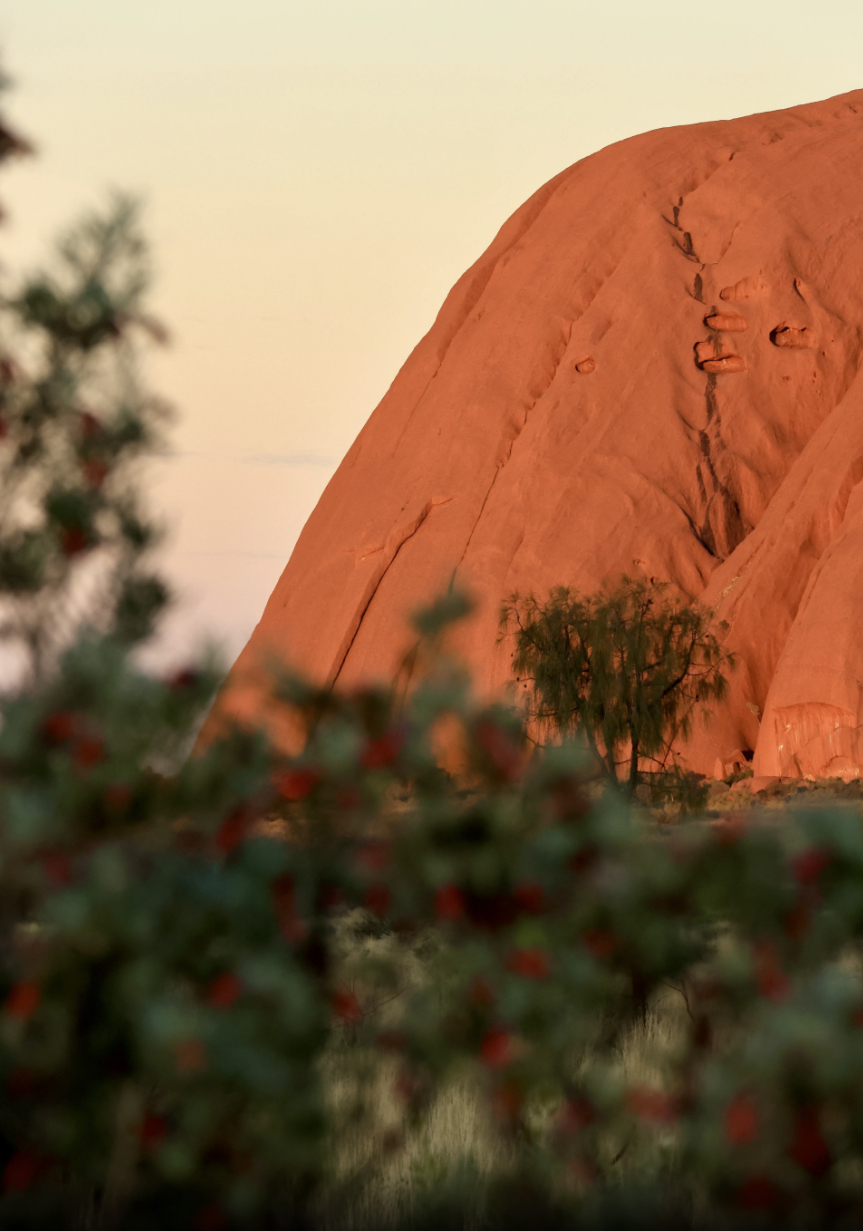
I thought I knew what to expect from Uluru. I'd seen the photographs, admired the colours, and had a pretty good idea of what I was going to find.
I was wrong.
There is something about being there that photographs simply cannot capture. The scale, the silence, the extraordinary colours. That feeling of being somewhere so ancient and significant that, for once, you don't particularly feel the need to say anything.
Which, if you know me, is quite something.
I came home thinking about Uluru far more than I expected to. Not just because it's beautiful, although it is ridiculously beautiful, but because of the way it made me feel. And naturally, because I'm incapable of switching off the designer part of my brain, I found myself thinking about materials, colours and textures the entire time.
The landscape is an absolute masterclass in colour. Deep rusts, burnt oranges, dusty pinks, muted greens and the most incredible earthy browns. Nothing matches in the conventional sense, yet everything belongs together.
I kept thinking about how easily we can overcomplicate colour in interiors. We spend hours comparing samples, trying to find the perfect combination, worrying about whether one shade is slightly too warm or another too cool. And then nature casually puts together a palette that no amount of Pinterest scrolling could improve upon.
The textures were equally fascinating. Weathered surfaces, deep grooves, soft curves and irregularities formed over an almost unimaginable amount of time.
Nothing polished. Nothing perfectly symmetrical. Nothing trying to look like anything other than what it is.
And perhaps that's what I found so beautiful about it.
I've always been drawn to materials with character. Stone with unexpected veining, plaster that isn't completely uniform, timber that shows its grain. The little imperfections that make something feel authentic rather than manufactured.
Being at Uluru only reinforced that appreciation.
But what stayed with me most wasn't something I could translate into a material palette.
Uluru is a sacred place for the Aṉangu people, the Traditional Owners, and understanding its cultural significance adds another dimension to the experience. It's a reminder that places carry meaning far beyond their physical beauty. They hold stories, knowledge and connections that can't be reduced to something visual.
I found that particularly moving.
We talk so much about creating beautiful spaces, and of course, that's a big part of what I do. But the places that stay with us are rarely memorable for their appearance alone. There's usually something else. A feeling, a memory, a connection that's harder to explain.
And then there's the space itself. That extraordinary sense of openness, the changing light, the way the landscape seems to shift colour throughout the day.
I love a beautifully layered interior. I love objects, art, unusual furniture and a little visual drama. I probably always will.
But there's something rather humbling about standing in front of a landscape that needs absolutely nothing added to it.
Not a single thing.
I didn't return from Uluru with some grand new design philosophy. I'm still going to obsess over marble samples, fall in love with furniture I don't need and occasionally convince myself that a room could benefit from one more interesting object.
But I did come home with a different kind of inspiration.
A greater appreciation for materials in their natural state. For colours that don't need to be perfectly coordinated. For the beauty of things that have been shaped by time rather than designed to look a certain way.
And a reminder that the most extraordinary places have a way of making you feel very small, in the best possible sense.
Some trips give you photographs and lovely memories.
Others stay with you in ways you don't quite expect.
Uluru was one of those.
Recent Posts


A maximalist at heart, I've always loved bold colours, beautiful objects and interiors with personality. But over time, I've come to appreciate the art of knowing when enough is enough. A reflection on restraint, the Italian concept of sprezzatura, and why the most interesting spaces aren't always the ones with the most to say.